If You Loved Interstellar — Watch These Cosmic Sci-Fi Films Next
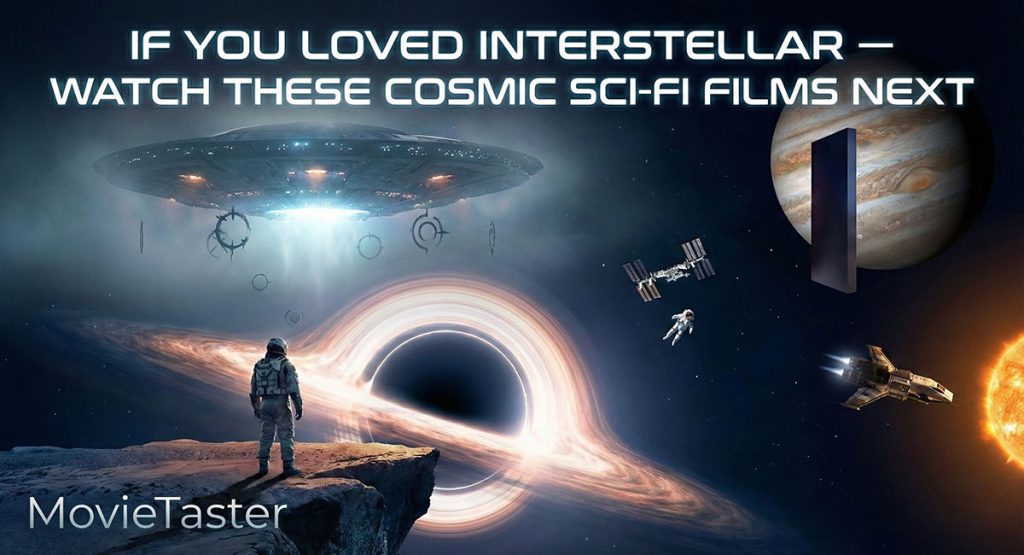
Some space movies are about rockets and missions.
Some are about aliens and technology.
But a rare few — like Interstellar — are really about being human inside an infinite universe.
If Interstellar stayed with you after the credits — not because of the visuals, but because of the feeling — the silence, the time paradox, the emotional weight, the father-daughter bond, the cosmic loneliness — then you’re not just looking for “space movies.”
You’re looking for cosmic experience films.
This list isn’t just sci-fi in space. These are films that match the Interstellar taste profile:
- emotional science fiction
- cosmic scale with human stakes
- philosophical undertones
- time, memory, identity
- awe + loneliness
- ideas that linger after watching
Not all of them are easy. Not all are fast. But each one connects to a different part of what made Interstellar unforgettable.
What Interstellar Fans Usually Love (Taste Map)
Before the list — let’s define the taste:
People who love Interstellar usually respond to at least 3 of these:
- scale + intimacy together
- science used as emotional engine
- time distortion themes
- existential wonder
- sacrifice and love across distance
- silence and sound design contrast
- ideas > action
- emotional payoff after intellectual buildup
Keep that lens while reading.
🎬 Arrival (2016)
If Interstellar moved you emotionally as much as intellectually, Arrival is your closest modern match.
This is not loud sci-fi. It’s contemplative sci-fi.
Where Interstellar uses physics to explore love across time, Arrival uses language to explore grief across time.
Both films build toward a revelation that redefines everything you’ve already seen — and both land that revelation emotionally, not just logically.
Best for: viewers who loved Interstellar’s emotional time structure more than its spectacle.
🎬 Contact (1997)
Think of Contact as Interstellar’s philosophical ancestor.
It blends:
- science
- faith
- cosmic curiosity
- personal belief
Like Interstellar, it asks:
What does discovery mean if it changes how we see ourselves?
It’s slower, more dialogue-driven, but deeply aligned in spirit — especially for viewers who loved the wonder and existential scale of first contact and cosmic meaning.
Best for: viewers who loved the spiritual side of Interstellar.
🎬 2001: A Space Odyssey (1968)
This is required viewing if you want to understand the DNA of cosmic cinema.
But be warned — this is not entertainment in the conventional sense. It’s cinematic meditation.
Interstellar is emotional and explanatory.
2001 is abstract and experiential.
No hand-holding. Long silence. Visual philosophy.
Watch it not for plot — but for perspective shift.
Best for: viewers who loved Interstellar’s awe and visual scale and want the purest form of cosmic cinema.
🎬 Sunshine (2007)
Sunshine starts like a scientific mission film — and slowly turns into a psychological and existential crisis.
It shares with Interstellar:
- mission stakes
- crew tension
- sacrifice themes
- proximity to cosmic power
- human fragility vs star-scale forces
It becomes darker than Interstellar — more intense, more claustrophobic — but emotionally adjacent.
Best for: viewers who liked the danger + sacrifice side of Interstellar.
🎬 Moon (2009)
If your favorite parts of Interstellar were the solitude and identity questions — Moon will hit hard.
Small scale. One actor. One base. One mystery.
This is intimate sci-fi — but philosophically big.
It explores:
- selfhood
- isolation
- memory
- human replaceability
Not visually epic — but conceptually sharp.
Best for: viewers who loved Interstellar’s loneliness more than its scale.
🎬 Ad Astra (2019)
This film divided audiences — but Interstellar fans often appreciate it more than average viewers.
Why?
Because it’s not really about space travel — it’s about emotional distance between fathers and sons, expressed through space travel.
Quiet. psychological. symbolic.
Think of it as:
therapy session in orbit
Best for: viewers who connected with Interstellar’s parent-child emotional core.
🎬 Gravity (2013)
Gravity shares Interstellar’s survival tension — but strips away philosophy and focuses on pure experiential immersion.
Less conceptual. More visceral.
It captures:
- isolation
- vulnerability
- fragility of human life in space
Watch this for sensory immersion and survival intensity.
Best for: viewers who loved Interstellar’s danger and realism moments.
🎬 Annihilation (2018)
This is cosmic sci-fi through the lens of psychological and biological mystery.
Less physics — more metaphysical dread.
It explores:
- unknown intelligence
- transformation
- self-destruction
- perception
Not space travel — but cosmic unknowability.
It’s beautiful and disturbing in equal measure.
Best for: viewers who liked Interstellar’s unknown and existential edge.
🎬 The Fountain (2006)
This is where the list becomes more taste-curated.
The Fountain is not science fiction in the conventional sense.
It’s a cosmic love poem disguised as sci-fi.
Non-linear time. Reincarnation motifs. Mortality. Eternal love.
Emotion > logic.
Some viewers find it overwhelming. Others find it transcendent.
If Interstellar’s emotional ending hit you harder than the science — this film is for you.
Best for: viewers who want cosmic emotion, not cosmic physics.
🎬 Solaris (1972)
Slow. philosophical. psychological.
Solaris is about memory, grief, and consciousness — using space as a mirror, not a setting.
It’s closer to psychological literature than modern sci-fi cinema.
Minimal action. Maximum introspection.
Do not watch this expecting Interstellar pacing.
Watch it expecting existential reflection.
Best for: viewers who loved Interstellar’s introspective loneliness.
🎬 The Creator (2023)
A modern addition — and more accessible than many films above.
Blends:
- large-scale sci-fi worldbuilding
- AI ethics
- war + compassion
- parent/child emotional thread
Visually rich and emotionally driven — with strong thematic overlap with Interstellar’s humanism inside technology.
Best for: viewers who want emotional sci-fi with modern production scale.
🌌 How to Choose Based on What You Loved Most in Interstellar
If you loved the emotional time twist:
→ Arrival
→ The Fountain
If you loved cosmic awe:
→ 2001
→ Contact
If you loved loneliness in space:
→ Moon
→ Solaris
→ Ad Astra
If you loved survival tension:
→ Gravity
→ Sunshine
If you loved existential unknown:
→ Annihilation
🎬 Final Thought
Interstellar worked because it didn’t choose between science and emotion — it fused them.
The films above each lean more toward one side of that spectrum.
Pick based on what you felt most strongly — not just what you watched.
That’s the MovieTaster way:
watch by taste, not by genre.